
PPWR Compliance for Cleanroom Wipes: What EU Buyers Now Check

The European rule that governs your wipe shipment is not about the wipe. It is about the bag, the label, the carton and the pallet wrap — and four of those obligations are already in force.
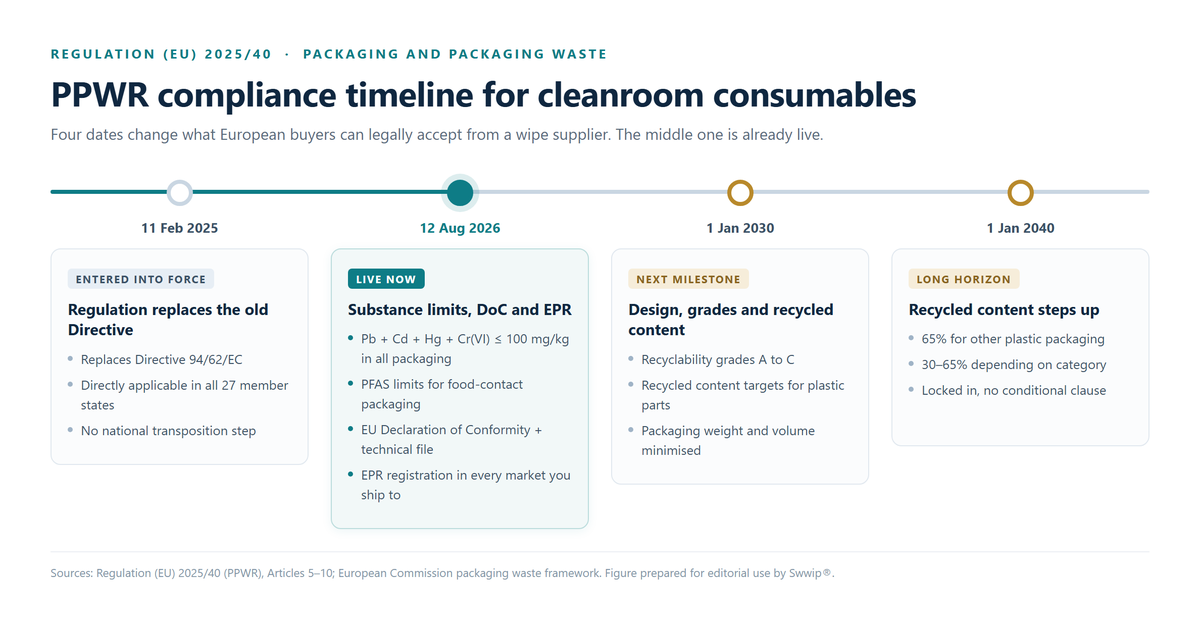
PPWR compliance for cleanroom wipes means the packaging around the wipe — liner bag, printed label, shipper carton and pallet wrap — must carry an EU Declaration of Conformity, stay within a 100 mg/kg combined limit for lead, cadmium, mercury and chromium VI, be registered under EPR in each destination country, and be traceable through a retained technical file. These obligations became applicable on 12 August 2026. Buyers are now requesting the evidence before the purchase order, not after delivery.
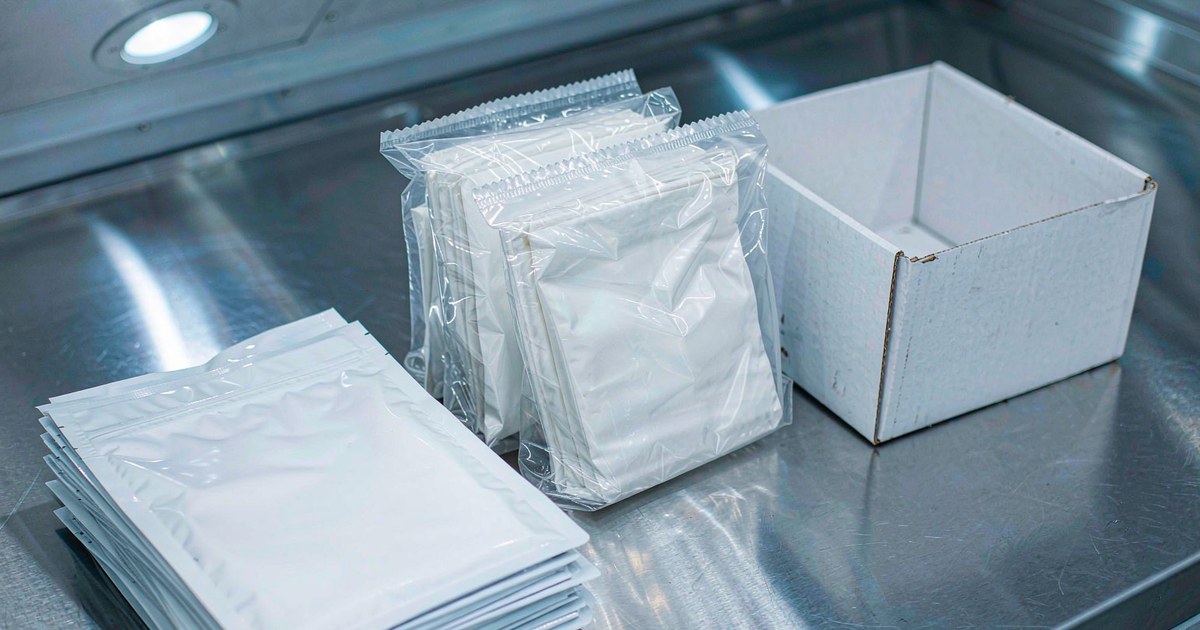
What PPWR actually requires from a cleanroom wipe supplier
The Packaging and Packaging Waste Regulation, Regulation (EU) 2025/40, entered into force on 11 February 2025 and replaced Directive 94/62/EC, which had governed European packaging for almost thirty years. Because it is a regulation rather than a directive, it applies directly in all 27 member states without a national transposition step. That removes the previous situation where the same shipment could be treated differently in Rotterdam and in Genoa.
For a consumables manufacturer, the practical consequence is that compliance is no longer a product question. A cleanroom wipe is a product. The pouch it sits in, the bag that pouch sits in, the label printed on that bag, the carton holding twenty bags and the stretch film around the pallet are all packaging, and all of them fall inside the scope of the regulation.
| Requirement | What it covers | Status |
|---|---|---|
| Heavy metals Pb + Cd + Hg + Cr(VI) ≤ 100 mg/kg |
Every packaging component, including inks, adhesives, coatings and laminates. No exemption for industrial packaging. | Live · 12 Aug 2026 |
| PFAS limits 25 ppb single, 250 ppb sum, 50 ppm total fluorine |
Food-contact packaging only. A standard industrial wipe pack is outside this clause, but a food-contact wipe line is not. | Live · 12 Aug 2026 |
| Declaration of Conformity plus technical file | Per packaging type, drafted by the manufacturer. Retained 5 years for single-use packaging, 10 years for reusable. | Live · 12 Aug 2026 |
| EPR registration | Registration in every member state where packaging is first placed on the market, with an authorised representative if the producer is outside the EU. | Live · 12 Aug 2026 |
| Design for recycling | Recyclability performance grades, with progressively stricter thresholds and a phase-out of low-grade formats. | From 1 Jan 2030 |
| Recycled content | Minimum post-consumer content in the plastic part — 35% for other plastic packaging in 2030, rising to 65% in 2040. | From 1 Jan 2030 |
| Minimisation and void ratio | Weight and volume kept to the necessary minimum, with empty space in sales packaging capped at 50%. | From 1 Jan 2030 |
Why this lands in a growing market, not a shrinking one
Compliance costs are easier to absorb in a market that is expanding, and the cleanroom consumables market is expanding. Mordor Intelligence puts the global market at USD 5.61 billion in 2025 and USD 6.01 billion in 2026, with a forecast of USD 8.51 billion by 2031 — a compound annual growth rate of 7.18% (Research and Markets, August 2026).
Two segments inside that total matter for wipes. Cleaning consumables account for roughly 35% of the market, and within that subset pre-saturated wipes hold a 42.3% share. Pre-saturated wipes are the most packaging-intensive format in the category: every unit needs a sealed barrier pouch, and the pouch is exactly the component that PPWR now scrutinises.
The demand side reinforces the same point. Global wafer fab capacity is projected to reach 33.7 million wafers per month, after growth of 6% in 2024 and 7% in 2025, and advanced nodes require ISO Class 1–3 environments where contamination control is non-negotiable. Capacity of that scale consumes wipes continuously — which means it also consumes liner bags, cartons and pallet film continuously, and generates EPR-declarable packaging volume in every market it serves.
The commercial reading is straightforward. When supply is growing and the rulebook is tightening at the same time, documentation stops being paperwork and becomes a qualification criterion. A buyer with three approved wipe suppliers and one compliance deadline does not renegotiate — they move the order.
Four packaging layers, four evidence trails
The most common documentation gap is not a missing certificate. It is a certificate that covers one layer and silently omits the others. A DoC issued for the outer carton says nothing about the polyethylene liner that actually touches the cleanroom pack, or about the solvent-based ink printed on the label.
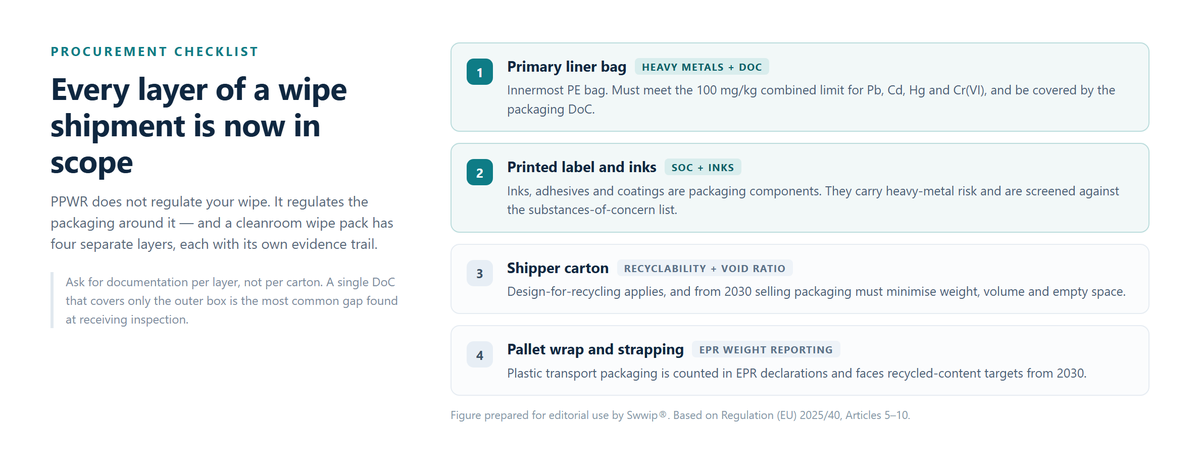
In practice, a packaging technical file for a wipe product should let you trace four things independently: the polymer and additives in the liner bag, the ink and adhesive system on the label, the board grade and any coating on the carton, and the film specification on the pallet. When a supplier can produce that structure on request, the rest of the compliance conversation tends to be short.
Five documents to request before your next purchase order
- An EU Declaration of Conformity for packaging, not for the product Product certificates are common and easy to supply. What PPWR requires is a declaration covering packaging types, signed by the manufacturer, backed by a technical file. Check that the declaration lists components rather than a single "packaging" line.
- A heavy-metal test report from an accredited laboratory Ask for the combined Pb, Cd, Hg and Cr(VI) figure against the 100 mg/kg limit, dated within the last twelve months, and confirm the sample set included printed and coated surfaces. Inks and coatings are where the limit is usually breached first.
- A written PFAS position, even if the clause does not apply If your product is not food contact, the correct answer is a documented "not applicable" with a total-fluorine figure if available. A blank response invites an audit question you will have to answer yourself, later, under time pressure.
- EPR registration evidence, with the responsibility split stated Registration usually sits with the entity placing the packaging on the market — in most supply chains that is the importer or brand owner, not the factory. What you need from the supplier is a clear written statement of who registers, who declares volume, and who pays the fee.
- A component list with recyclability and recycled-content status This is not yet mandatory for most formats, but it is what separates a supplier who will still be approved in 2031 from one who will be re-sourcing the bag under deadline pressure. Mono-material polyethylene and water-based inks are the usual direction of travel.
Where suppliers usually fail — and the questions that expose it
Compliance failures in this category are rarely dramatic. They surface as a missing signature, a test report covering the wrong substrate, or a declaration that describes a packaging design the factory stopped using two years ago. The table below is a short audit script for a procurement or quality team.
| Question | Weak answer | What to accept instead |
|---|---|---|
| "Which packaging components does your DoC cover?" | "All of it — it is standard packaging." | A component list: liner bag, label, carton, film, with a material and supplier named for each. |
| "When was the heavy-metal test run, and on which surfaces?" | "Our material supplier certifies it." | An accredited report under twelve months old that explicitly includes printed areas. |
| "Who is the EPR producer of record for our shipments?" | "Our forwarder handles that." | A named legal entity per destination country, in writing, before the first shipment. |
| "Can the pouch move to mono-material PE?" | "Not without a full redesign and new tooling." | A dated roadmap, or an honest statement of the barrier trade-off involved. |
| "What changes in the packaging between now and 2030?" | "Nothing — the rules are not final." | A plan covering recyclability grade, recycled content and void ratio, with owners. |
The cost conversation nobody enjoys
It would be dishonest to present PPWR as a documentation exercise with no price tag. Three changes carry real cost. Moving a barrier pouch to a mono-material structure can reduce moisture protection and may require a thicker film to compensate. Water-based inks behave differently on polyethylene than solvent-based inks and can slow line speed. Post-consumer recycled content, once the 2030 thresholds bite, usually carries a premium and needs a traceable supply chain behind it.
Against that, the cost of a rejected consignment is not the consignment. It is the air freight for a replacement, the deviation report, the audit finding and the twelve months of reduced trust that follow. For most European buyers the comparison is not close, which is why the documentation request has moved forward in the process — from the annual audit to the quotation stage.
One timing detail is worth flagging to finance teams. The 2030 recycled-content date is conditional: it applies from 1 January 2030, or three years after the implementing act that sets the calculation method enters into force, whichever is later. That act is due by the end of 2026. Until it is published, recycled-content percentages quoted by any supplier are planning assumptions rather than verified figures.
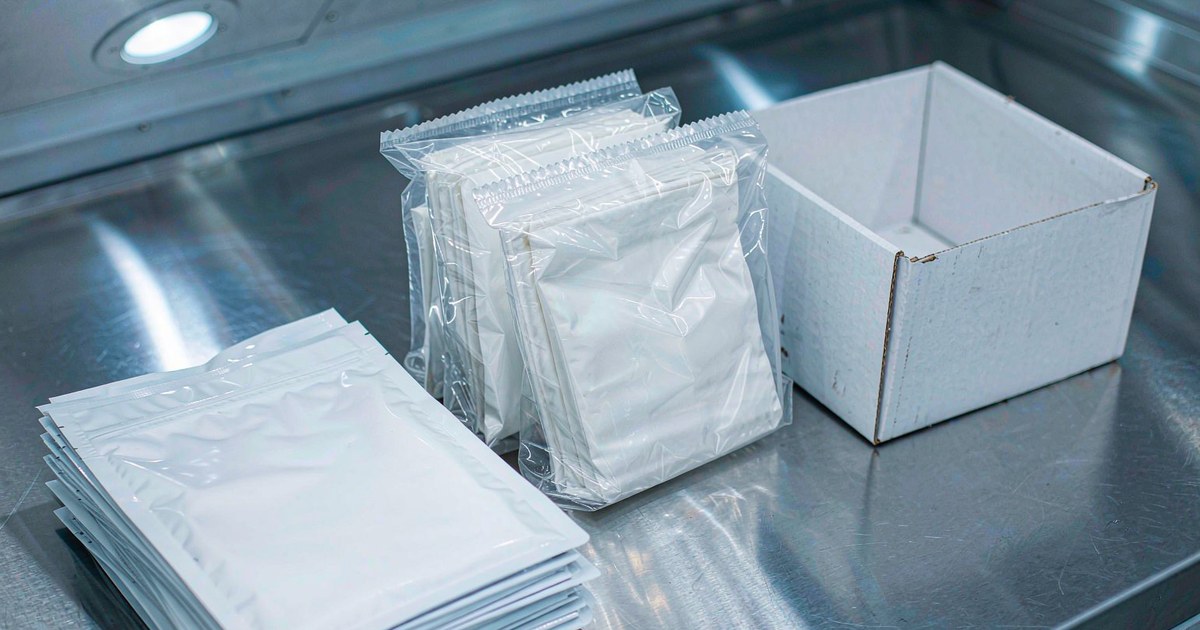
How Swwip approaches packaging documentation
Shenzhen Swwip Technology has manufactured cleanroom consumables for more than twenty years, and labels and packaging are printed and assembled in-house rather than bought in as a finished component. That matters for PPWR specifically: when the printed label, the bag and the carton are specified by one supplier, the material declarations behind them come from a single point of contact instead of three, and a change to one component does not quietly invalidate a declaration issued for another.
The product range relevant to this regulation is broad enough that a single packaging strategy will not fit every line. Dry cleanroom polyester wipes are supplied in 115, 120 and 140 GSM weights across 6 x 6 and 9 x 9 inch formats, in liner bags and cartons. Microfiber cleanroom wipes cover 105 to 180 GSM and need different barrier protection. Pre-saturated IPA wipes are the most demanding format, because a solvent-filled pouch combines packaging compliance with chemical compatibility. Dry wipes rolls and cleanroom mops carry larger packaging footprints and therefore larger EPR-declared volumes.
For buyers building a technical file, three practical points are worth knowing. Samples are available within two days, so a packaging specification can be reviewed physically before a bulk order rather than from a drawing. Custom label and packaging design is handled in-house, which makes it possible to specify a compliant label structure from the start rather than retrofitting one. And the technical documentation set for the EU market is maintained in English, Spanish and Italian, matching the three language versions of this website — a small detail that matters when a distributor in Milan or Barcelona is the one answering the authority's question.
For a wider comparison of wipe specifications and how they are priced against established brands, the cost-performance analysis of cleanroom wipes covers the selection side of the same decision. Buyers working specifically on semiconductor lines will find the polyester wipe selection guide a useful companion to this article.
Frequently asked questions
Does PPWR apply to the cleanroom wipes themselves?
No. PPWR regulates packaging and packaging waste, not the product inside it. A dry wipe is a product. A pre-saturated wipe sold in a sealed pouch is a product inside packaging, and the pouch is fully in scope. The distinction matters because suppliers sometimes use "our product is not packaging" as a reason to provide nothing, when in fact four packaging components still require evidence.
Is PPWR the same as CE marking?
No, and the two are assessed separately. CE marking concerns product safety law; PPWR concerns packaging composition, documentation and end-of-life. A product can hold every product certificate it needs and still be refused at the border because its packaging lacks a Declaration of Conformity or is not registered under EPR.
Who is responsible for EPR registration — the factory or the importer?
Responsibility follows whoever places the packaging on the market of a member state. In most supply chains that is the EU importer or the brand owner holding the product, not the Chinese manufacturer. A producer established outside the EU must appoint an authorised representative in the member state concerned. Because the split varies by contract, it should be stated in writing rather than assumed.
What happens if non-compliant packaging arrives at an EU port?
The regulation provides no stock transition period for packaging that fails the substance limits. In practice, non-compliant packaging faces refusal at the border, delisting by marketplaces, or a recall obligation depending on the member state's enforcement approach. Enforcement authority sits with national authorities, which is one reason documentation quality varies so much between one country and the next.
Do we need to change our wipe specification to comply?
Usually not. PPWR does not dictate wipe material, GSM or construction. What it changes is the packaging that carries the wipe, and in some cases the label content. Where a specification change does become necessary, it is normally driven by the 2030 recyclability and recycled-content requirements rather than by the 2026 substance limits.
Need the packaging documentation before your next audit?
Tell us the destination country, the packaging format and the wipe model you are qualifying. We will come back with the component list, the material declarations and a sample timetable.
Request documentation and samplesSources
- Regulation (EU) 2025/40 of the European Parliament and of the Council on packaging and packaging waste, EUR-Lex.
- European Commission, packaging and packaging waste policy framework, environment.ec.europa.eu.
- Mordor Intelligence, Cleanroom Consumables — Market Share Analysis, Industry Trends and Growth Forecasts 2026–2031, August 2026.
- European Chemicals Agency, PFAS restriction background, echa.europa.eu.
 How to Choose Cleanroom Polyester Wipes for Semiconductor and Electronics Manufacturing
 Swwip vs. Texwipe: A Cost-Performance Analysis for Cleanroom Wipes in 2026
 Swwip® Industrial Lint-Free Blue Dry Wipes Roll – Reliable Solution for High-Performance Cleaning
 Why use 70 percent isopropyl alcohol wipes for cleaning?
 What kind of cloth is the cleanroom lint free microfiber cleaning cloth?
 Cleanroom Microfiber Cleaning Wipes: Key Cleaning Tools in High-Clean Environments
 Swwip cleanroom non woven cleaning wipes
 Applications of industrial wiper roll in industrial production
 Sterile Cleanroom Wipes - ideal choice for the pharmaceutical and food industry
 How to test the quality of cleanroom wipers?
 The Importance of Keeping a Cleanroom Clean
 Characteristics of cleanroom lint free cleaning wipes
 How to choose the suitable cleanroom wipes?
 What do cleanroom wiper do?
 How to clean a sterile cleanroom?
 About 3000 series sub-microfiber cleanroom wipes
 How to maintain the performance of microfiber cleanroom wiper?
 How to distinguish the level or class of dust-free cleanroom wiper?
 How to judge the cleanliness of the cleanroom wiper?
 The function of anti-static ESD cleanroom wiper